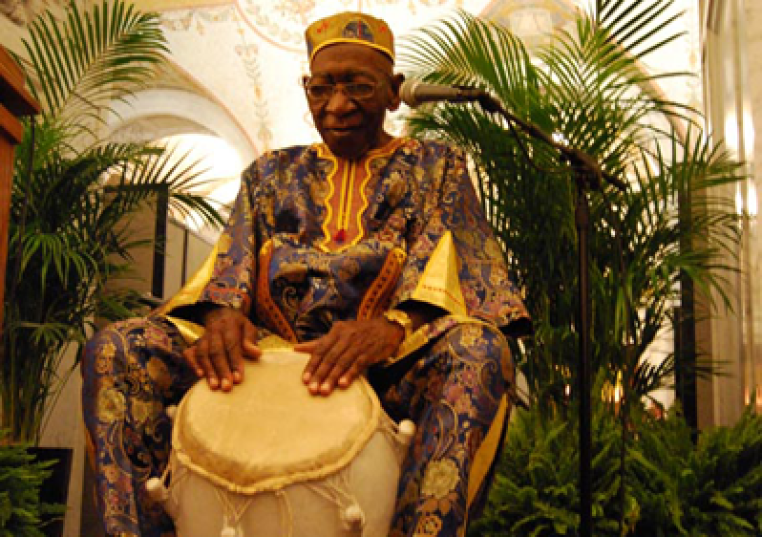
Yacub Addy (April 15, 1931[1] – December 18, 2014)[2] was a Ghanaian traditional drummer, composer, choreographer and educator who collaborated with many musicians in various genres, including Wynton Marsalis.[3][4] He has been referred to as “the leading ambassador of Ghanaian music and culture”. Starting in 1995, Addy taught percussion and West African drumming at Skidmore College in Saratoga Springs, New York.[6] He also taught at Rensselaer Polytechnic Institute in Troy, New York. He was a recipient of a 2010 National Heritage Fellowship awarded by the National Endowment for the Arts, which is the United States government’s highest honor in the folk and traditional arts. Addy was born in 1931 into the Ga ethnic group in the village of Avenor, outside of Accra, Ghana.[2] His father was Jacob Kpani Addy (“Okonfo Akoto”), a wonche or medicine man who integrated rhythmic music into healing and other rituals.[8] His mother was Akua Hagan, a lead singer in her husband’s medicine music.[6] His maternal grandmother was also an Okonfo (“Okonfo Ablabah”).[8] His father had 10 wives over the course of his life, and more than 50 children.[8][9] His extended family included many drummers, singers, and dancers, including brothers Obo Addy and Mustapha Tettey Addy. As a teenager, Addy started to play the adowantsre drum, which is a supporting drum played with the hands, as part of his father’s medicine music.[8] His primary drumming teacher was his older brother Tetteh Koblah Addy (“Akwei Wejei”). At age 16, Addy became a Muslim, the first in his family. At that time he changed his forename from Jacob to Yacub,[8] with his father’s blessing. In 1956, the year before Ghana gained independence from British colonial rule, Addy organized and led the first major staged performance of traditional Ghanaian music and dance.[8] He was the founder of the group Ashiedu Ketrekre, which had two units: an adult group of 40 members with drummers, singers, and dancers and a children’s group. The adult ensemble was the first traditional group to play at Ghanaian hotels as well as for funerals of political and cultural figures. The children’s group was the first traditional group to play on Ghanaian television. The children’s group also performed during a visit by then-First Lady of the United States Pat Nixon. He formed the small group Oboade in 1968, consisting of himself, some of his brothers and a friend.[8] Oboade was the first professional traditional Ghanaian ensemble to tour in the West, from 1972 to 1975.[2][8] Their first European concerts were at the 1972 Summer Olympics in Munich, where they were well received. Oboade was based in London from 1972 to 1975, and it was there that Addy met his future wife and manager, Amina, an African-American woman. The group toured throughout Europe and the United States during that time. Their U.S. concerts included shows in Maryland and Chicago but many were held in the Pacific Northwest.[8] After Oboade disbanded, the Addy family moved to Seattle in 1975, where he found work performing and teaching. In 1982 while he was living in the Washington, D.C. area,[10] Addy formed the ensemble Odadaa!, composed primarily of Ga artists and which remained active for decades. The group’s name translates as “Let the music begin!”[1] They performed both traditional Ghanaian music and dance, arranged and choreographed by Addy, as well as collaborations with artists from other traditions such as kora and jazz.[6] Two of Addy’s brothers performed with Odadaa! for many years. Odadaa! made their first appearance at the New Orleans Jazz & Heritage Festival in 1984. Addy had wanted to visit the city ever since he heard Louis Armstrong talk about his hometown and its history during Armstrong’s visits to Accra in the 1950s. Addy loved jazz and wanted to know more about the area called Congo Square and specifically the rhythms that Africans played there.[11] On his 1984 trip to New Orleans, Addy made his first visit to Congo Square, located within present-day Louis Armstrong Park. In 1993, Addy moved to the Capital Region of New York. In 2005, Addy premiered his work “Kolo” with jazz vibraphonist Stefon Harris. In 2010, Addy and Odadaa! were artists-in-residence at the Empire State Plaza Performing Arts Center (“The Egg”) in Albany, New York. In 1956, the year before Ghana gained independence from British colonial rule, Addy organized and led the first major staged performance of traditional Ghanaian music and dance.[8] He was the founder of the group Ashiedu Ketrekre, which had two units: an adult group of 40 members with drummers, singers, and dancers and a children’s group. The adult ensemble was the first traditional group to play at Ghanaian hotels as well as for funerals of political and cultural figures. The children’s group was the first traditional group to play on Ghanaian television. The children’s group also performed during a visit by then-First Lady of the United States Pat Nixon. He formed the small group Oboade in 1968, consisting of himself, some of his brothers and a friend.[8] Oboade was the first professional traditional Ghanaian ensemble to tour in the West, from 1972 to 1975.[2][8] Their first European concerts were at the 1972 Summer Olympics in Munich, where they were well received.Oboade was based in London from 1972 to 1975, and it was there that Addy met his future wife and manager, Amina, an African-American woman. The group toured throughout Europe and the United States during that time. Their U.S. concerts included shows in Maryland and Chicago but many were held in the Pacific Northwest.[8] After Oboade disbanded, the Addy family moved to Seattle in 1975, where he found work performing and teaching. In 1982 while he was living in the Washington, D.C. area,[10] Addy formed the ensemble Odadaa!, composed primarily of Ga artists and which remained active for decades. The group’s name translates as “Let the music begin!”[1] They performed both traditional Ghanaian music and dance, arranged and choreographed by Addy, as well as collaborations with artists from other traditions such as kora and jazz.[6] Two of Addy’s brothers performed with Odadaa! for many years. Odadaa! made their first appearance at the New Orleans Jazz & Heritage Festival in 1984. Addy had wanted to visit the city ever since he heard Louis Armstrong talk about his hometown and its history during Armstrong’s visits to Accra in the 1950s. Addy loved jazz and wanted to know more about the area called Congo Square and specifically the rhythms that Africans played there.[11] On his 1984 trip to New Orleans, Addy made his first visit to Congo Square, located within present-day Louis Armstrong Park. Addy died of a heart attack on December 18, 2014, at age 83. He was following behind an ambulance that was taking his wife to the hospital after she suffered an anaphylactic reaction. He experienced cardiopulmonary arrest while driving and died in the same emergency room at Albany Medical Center where his wife was being treated. Amina was released from the hospital on December 20 and Yacub was buried the following day in the Islamic tradition. Addy was survived by his wife and nine children. At the time of his death, he had nine living siblings in Africa and two in Virginia. The Addys lived in Latham, New York.