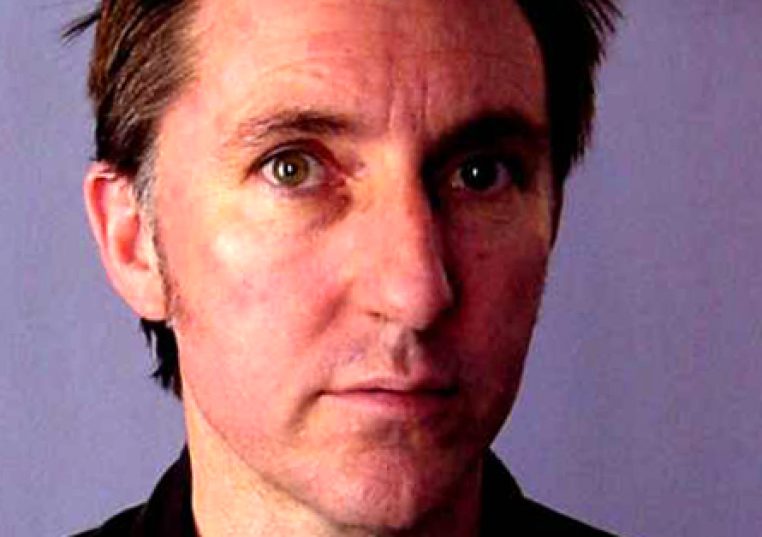
Warrick Swinney (born in 1958), more commonly known as Warrick Sony, is a South African composer, producer, musician and sound designer. He is the founder and sole permanent member of the Kalahari Surfers. They made politically radical satirical music in 1980s South Africa, and released it through the London-based Recommended Records. During this time the Surfers toured Europe with English session musicians. Sony has produced albums, and ran the Shifty Music label at BMG (Africa) for two years in the mid-1990s. He has also worked as a film sound recordist, sound designer and sound artist. Now based in Cape Town, Sony has released more Kalahari Surfers albums, and been involved in art, music and DJ events in the city. He currently works on film scores, music for theatre and sonic art exhibitions. He graduated with a Master of Fine Art degree in 2019 from Michaelis School of Art University of Cape Town. Sony was born in Port Elizabeth on 12 September 1958.[1] He grew up in the Cowies Hill area of Durban, attending Westville High School where he played in school-based groups doing covers of songs by Jimi Hendrix and The Who.[2] He was influenced by Indian music and cuisine and by the work of Frank Zappa and Captain Beefheart.[3] He learned to play tabla at the Hindu Surat school in Durban.[4] In 1976 he was conscripted into the South African Defence Force, where he declared himself a Hindu pacifist, and was assigned to medical duties and then to band work.[2] During his military service, Sony played B♭ horn, euphonium and drums.[5] He changed his surname from Swinney to Sony to make it harder for the army to get in touch with him for camps; he chose Sony because he liked their products.[6] While Sony was in the army in 1977, his father brought him punk rock albums from an overseas trip. This was his first exposure to the Sex Pistols and the Clash. The Kalahari Surfers are a “fictional group” which have served as a long-standing stage name for Warrick Sony’s music.[7] He is the only permanent member of the band, and brings in other musicians as and when needed. He adopted the name partly to protect himself from the authorities.[5] The Surfers’ music was the first radical white anti-apartheid pop in South Africa,[8] and began with a 1982 home-recorded cassette titled “Gross National Products”. Sony distributed it himself;[9] the South African Sunday Times described it as a “daring home-mixed collection of subliminal jive rhythms, sad-sweet jazz sounds, tabla burps, church bells, bird shrieks, political speeches and… other… found sounds”,[10] and chose it as one of their three “Terrific Tapes of 1983”.[11] The second release was a double single package, “Burning Tractors Keep Us Warm”, released by Pure Freude Records. German group Can were involved with this label. Warrick Sony worked as a freelance sound engineer in the South African film industry, and used this to acquire many of the sound samples he later used in his music.[13] Shifty Records tried to release the 1984 album Own Affairs, but could not find a vinyl plant which would press it.[14] Chris Cutler’s London-based Recommended Records pressed the album, the start of a long-standing alliance. Own Affairs was hailed as breathtaking, innovative and humorous by the Weekly Mail.[15] The Sunday Times called it “a music born from the spilled seed of our national sickness and nurtured to nightmarehood in the moral drought of daily life/politics”.[16] Cutler helped set up tours, and in 1985 a second album, Living in the Heart of the Beast, was released.[17] Jon Savage wrote in the New Statesman that it was a “success”, praised its “viciously critical (and historically intelligent) lyrics”, and compared it with early Zappa.[18] The NME called it “brave”.[19] The third album, Sleep Armed (1987), has been called “the best snapshot we have of South Africa at the time, right down to the jacket photo of rich surfers on Umhlanga Roxx, a posh White beach in Durban”. In 1986, with a live band comprising Mick Hobbs on bass, Alig (from Family Fodder) on keyboards, Tim Hodgkinson (keyboards, sax and slide guitar), and Chris Cutler on drums,[2] Sony performed in the Netherlands, Germany, Switzerland, France, Luxembourg, the Festival des Politischen Liedes in East Berlin, and London. In 1989 they were the first South African band invited to play in the Soviet Union, where they played Moscow, Leningrad, and Riga. In 1989 the South African authorities banned the fourth album Bigger Than Jesus,[21] due to concerns about the song “Gutted with the Glory”‘ and the use of the Lord’s Prayer. This album was deemed “abhorrent and hurtful”. A shopper, Mevrou Mulder of Cape Town, was so offended by seeing the record on sale that she organised a petition to the Directorate of Publications. She complained: “The name alone is enough to make any Christian furious, not to mention the words. We as reborn Christians object to the publication of this record and also the distribution of it.”[22] Sony successfully appealed, and the record was unbanned on condition that the name was changed to Beachbomb.[23][24] Personality magazine said the album “alternates between sheer poetic brilliance and intellectual nonsense.”[25] The first three albums remained banned in South Africa. Sony worked as a sound recordist (for many foreign networks including ABC, CBS, BBC ) covering the defiance campaign and consequently the release from prison of Nelson Mandela in February 1990. He has used some of the recordings he made as a journalist in his musical work.[7] He worked with Donald Woods on a documentary at this time.[13] Sony worked with Lloyd Ross at Shifty Records from 1992, mostly concentrating on developing and promoting foreign African music in South Africa. He bought the studios first 16-track recording[27] machine and became a partner in the company when Ivan Kadey emigrated. As a sound designer Sony worked on the feature film The Mangler, directed by Tobe Hooper.[52] He co-composed (with Murray Anderson) the score for Canadian Broadcasting documentary Madiba: The Life and Times of Nelson Mandela (1996), for which he was awarded the Gemini Award for best music.[53] He composed music for Gerrie & Louise (1997), sound design for Izulu lami (2008) and sound for Zimbabwe (directed by Darryl Roodt, 2008)[54][55] In 2010 he wrote music for Jozi, a comedy directed by Craig Fremont produced by Thom Pictures and Anant Singh. He worked with Rodney Place on the Couch Dancing exhibition.[57] He did music for Ochre and Water: Himba chronicles from the land of Kaoko for Doxa Productions.[58] He worked with Murray Anderson to make music for the Museum of Rock Art[59] and in March 2007, with Pops Mohamed and Dizu Plaatjie’s band Ubuyambo performed at Turbulence, the South African art exhibition in Red Bull’s Hangar 7 event in Salzburg. He has been involved in multimedia theatre productions such as William Kentridge’s Ubu and the Truth Commission (with Brendan Jury)[61][62] and Faustus in Africa,[63] and Handspring Puppet’s Tall Horse. Television credits include Apartheid’s Last Stand (1999) and Parklife: Africa (2001). He worked on commercials, film scores and music for theatre.[65] He was based at Milestone Studios, Cape Town, and his advertising work included commissions from Nissan, Daewoo, Land Rover, and BMW. Sony exhibited two video works at the 56th Venice Biennale at the South African Pavilion. Warrick left Milestone to concentrate on his master’s degree which he completed with distinction, at Michaelis School of Fine Art at the University of Cape Town in 2019.[67] His final examination work was shown at a solo show at the Michaelis Gallery in November 2018. In 2020 he received a Mellon Foundation Turning the Tide scholarship and enrolled to do his PhD through UWC. (the University of the Western Cape). In September 2022 he attended the Bauhaus University/Goethe Institute offered 3-month Radio Art Residency residency in Weimar Germany, producing a body of work which was exhibited at the Eigenheim Gallery under the title, “Mutant Farmyard Activities” (03-15 December). He also completed a 55 minute radio art piece titled Vuvuzela’s and Sun Damage for Deutschlandfunk Kultur, another of the Radio Art Residency sponsors. In May 2023 he submitted his completed dissertation for a Phd at the University of the Western Cape. It is titled “Signal To Noise – sonic reflections on the South African transition period (1984-1998)”