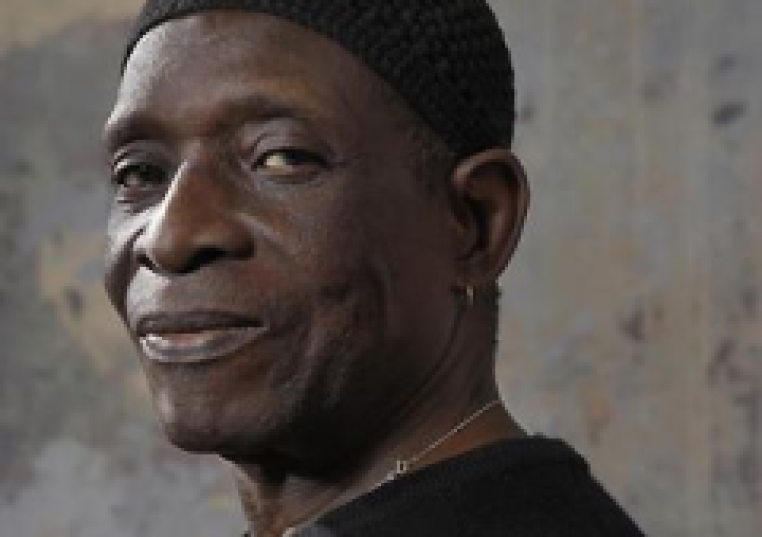
Tony Oladipo Allen (20 July 1940 – 30 April 2020)[1] was a Nigerian drummer, composer, and songwriter who lived and worked in Paris, France. Allen was the drummer and musical director of Fela Kuti’s band Africa ’70 from 1968 to 1979, and was one of the founders of the Afrobeat genre. Fela once stated that “without Tony Allen, there would be no Afrobeat”.[2] He was described by Brian Eno as “perhaps the greatest drummer who has ever lived”. Allen was born in Lagos, Nigeria to James Alabi Allen, a motor mechanic from British Nigeria (now present day Nigeria) and Prudentia Mettle, from the Gold Coast (now present day Ghana),[6][1] He began playing drums at the age of 18, while working as an engineer for a radio station. Allen was influenced by music his father listened to: Jùjú, a popular Yoruba music from the 1940s, but also American jazz, and the growing highlife scene in Nigeria and Ghana. Allen worked hard to develop a unique voice on the drums, feverishly studying LPs and magazine articles by Max Roach and Art Blakey, but also revolutionary Ghanaian drummer Guy Warren (later known as Kofi Ghanaba – who developed a highly sought-after sound that mixed tribal Ghanaian drumming with bop – working with Dizzy Gillespie, Charlie Parker, Thelonious Monk, and Max Roach). Allen was hired by “Sir” Victor Olaiya to play claves with his highlife band, the Cool Cats. Allen was able to fill the drum set chair when the former Cool Cats drummer left the band. Allen later played with Agu Norris and the Heatwaves, the Nigerian Messengers, and the Melody Makers. In 1964, Fela Kuti invited Allen to audition for a jazz-highlife band he was forming. Kuti and Allen had played together as sidemen in the Lagos circuit. Fela complimented Allen’s unique sound: “How come you are the only guy in Nigeria who plays like this – jazz and highlife?” Thus Allen became an original member of Kuti’s “Koola Lobitos” highlife-jazz band. In 1969, following a turbulent and educational trip to the United States, Allen served as the musical director of Fela’s band, Africa ’70,[7] which developed a new militant African sound, mixing the heavy groove and universal appeal of soul with jazz, highlife, and the polyrhythmic template of Yoruba conventions. Allen developed a novel style to complement Fela’s new African groove that blended these disparate genres. Allen recounted how he and Fela wrote in 1970: “Fela used to write out the parts for all the musicians in the band (Africa ’70). I was the only one who originated the music I played. Fela would ask what type of rhythm I wanted to play.… You can tell a good drummer because we… have four limbs… and they are… playing different things… the patterns don’t just come from Yoruba… [but] other parts of Nigeria and Africa.” Allen recorded more than 30 albums with Fela and Africa ’70. But by the late 1970s, dissension was growing in the ranks of Africa ’70. Arguments over royalties/pay and recognition grew in intensity. As inventor of the rhythms that underpinned Afrobeat and musical director, Allen felt especially slighted. Fela stood his ground, stating that he would get the royalties for his songs. Fela did support Allen’s three solo recordings: Jealousy (’75), Progress (’77), No Accommodation For Lagos (’79), but by 1979, Allen chose to leave Africa ’70, taking many members with him. “‘What makes me decide it’s time to go? It’s … everything…and (his) carelessness…like he doesn’t care, like he doesn’t know …he doesn’t feel he’s done anything (wrong). And with all the parasites around too…. there were 71 people on tour by now and only 30 working in the band….you got to ask why. Those guys were sapping Fela of his Force, of his Music.’ So Tony moved on, once again in search of his own sound.” Allen formed his own group, recording No Discrimination in 1980, and performing in Lagos until emigrating to London in 1984. Later moving to Paris, Allen recorded with King Sunny Adé, Ray Lema and Manu Dibango. Allen recorded N.E.P.A. in 1985. Post-Fela, Allen developed a hybrid sound, deconstructing and fusing Afrobeat with electronica, dub, R&B, and rap. Allen refers to this synthesis as afrofunk. Allen returned with a much anticipated new project for his 13th release. Recorded live in Lagos, with a full-sized Afrobeat band, Lagos No Shaking (Lagos is OK) signified Allen’s return to roots Afrobeat after forays into avant-garde electronica hybrids. Lagos No Shaking was released on 13 June 2006. In the single “Music Is My Radar” (2000) Blur pay homage to him, and the song ends with Damon Albarn repeating the phrase “Tony Allen got me dancing.” On 30 April 2020, Allen died of abdominal aortic aneurysm at Georges Pompidou European Hospital in Paris.[1] Tributes came from musicians and producers including Flea, Peter Gabriel, Jeff Mills, Nigel Godrich and Sean Lennon.[1][26] Damon Albarn noted that “I will never, ever play with anyone like him again. He is my number one musical teacher”.