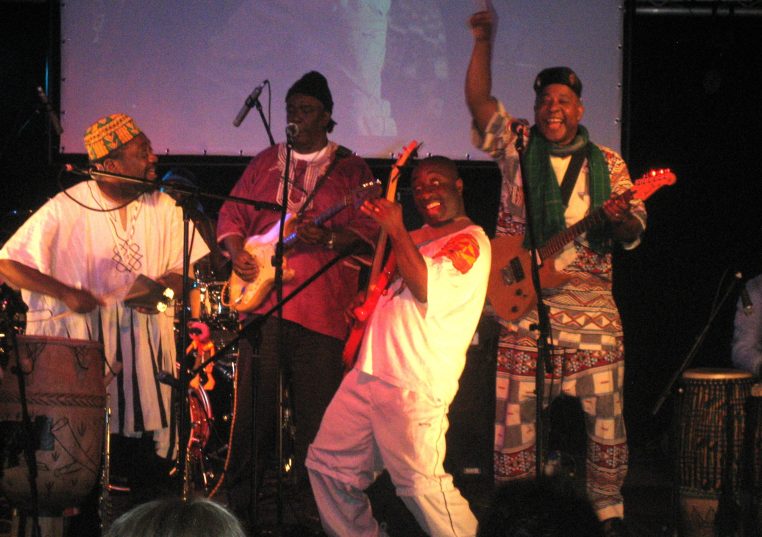
In Ghana in the 1950s, Teddy Osei (saxophone), Soloman (Sol) Amarfio (drums), Mamon Shareef, and Farhan Freere (flute) played in a highlife band called The Star Gazers.[2] They left to form the Comets, with Osei’s brother Mac Tontoh on trumpet, and scored a hit in West Africa with their 1958 song “(I Feel) Pata Pata”.[2] In 1962, Osei moved to London to study music on a scholarship from the Ghanaian government. In 1964, he formed Cat’s Paw, an early “world music” band that combined highlife, rock, and soul. In 1969, Osei persuaded Amarfio and Tontoh to join him in London, and Osibisa was born.[2] Joining the three Ghanaians in the first incarnation were Antiguan Wendell (Dell) Richardson (lead guitar and lead vocalist), Nigerian Lasisi Amao (percussionist and tenor saxophone),[2] Grenadian Roger Bedeau also known as Spartacus R (bass) and Trinidadian Robert Bailey (keyboards). Nigerians Mike Odumosu and Fred Coker (bass guitar) were later replacements.The band spent much of the 1970s touring the world, playing to large audiences in Japan, Australasia, India, and Africa. During this time Paul Golly (guitar) and Ghanaians Daku Adams “Potato” and Kiki Gyan were also members of the band. In January 1976, their single, “Sunshine Day”, reached number 17 on the UK Singles Chart. Their next single release, “Dance the Body Music”, peaked at number 31 in the same listing.[3] In 1980, Osibisa performed at a special Zimbabwean independence celebration, and in 1983 were filmed onstage at the Marquee Club in London but by this stage were a distant relative of the original band.Osibisa had an important series of gigs in India in 1981 culminating in the release of the Unleashed – Live in India album. The band engaged in a return to India performing at the November Fest 2010 on 28 November 2010, at the Corporation Kalaiarangam in Coimbatore, Tamil Nadu.[4]Changes in the music industry meant declining sales for the band, and a series of label changes resulted. Some of the band returned to Ghana to set up a recording studio and theatre complex to help younger highlife musicians.In the 1990s, their music was anthologised in many CD collections, with some of them allegedly unauthorised and paying no royalties whatsoever to the band. This has been disputed by Osei however who, along with Amarfio and Tontoh, ran the band from the 1980s onwards. In the early 1990s, Osei regrouped the band, and many of their past releases began coming out properly and legally on CD. This included a remaster series with bonus material and various new releases of hitherto unreleased material and live concerts on the Red Steel / Flying Elephant label collaboration. Osei regrouped the band in 1994 after commencing work with two UK labels. Castle Communications (who had the licensing rights to the Buddah catalogue and some of the Bronze Records catalogue) and Red Steel Music who specialised in remastering and reissuing albums on CD. With a new producer and label behind him Osei progressed on recording new material culminating in the 1995 release of Monsore, the bands first album of new material since the late 1980’s Movements album. The revitalised band with Osei firmly at the helm commenced touring and recording fairly consistently until Osei’s stroke some fifteen years later. Osei cut back his touring schedule due to the effects of his illness but still continued to record until 2018. Various new recording and release projects were carried out from the mid-1990s onwards with remastered, remixed and re-recorded projects seeing the light of day on a fairly consistent basis. This included previously unreleased material from the African Flight period, the incomplete follow up which had a working title of African Dawn, live projects including Live at Cropredy the bands first live album in fifteen years followed by the semi acoustic live offering recorded at London’s famous Jazz Cafe, Aka Ka Kra. Work commenced on more studio material that remains unissued to this day. A new studio album, Osee Yee was released in 2009. After the removal of personnel by Osei in 2014/15, a new recording project with Osei at the helm commenced in late 2015, shortly after the successful placement of material that was chosen for Richard Linklater’s, Boyhood. However, apart from one track included on the band’s 2020 The Boyhood Sessions album, these recordings featuring Osei remain unreleased to date. The name Osibisa was described in lyrics, album notes and interviews as meaning “criss-cross rhythms that explode with happiness” but it actually comes from “osibisaba” the Fante word for highlife.[5][6] Ace Ghanaian hip-hop music producer Hammer of The Last Two stated that his debut production, Obrafour’s Pae Mu Ka album, the highest selling hiplife album to date, was inspired by a single song (“Welcome Home”) by Osibisa. He also had the chance to work with Kiki Gyan a few days before his death. On 13 December 2022, drummer and founding member Sol Amarfio died at the age of 84.