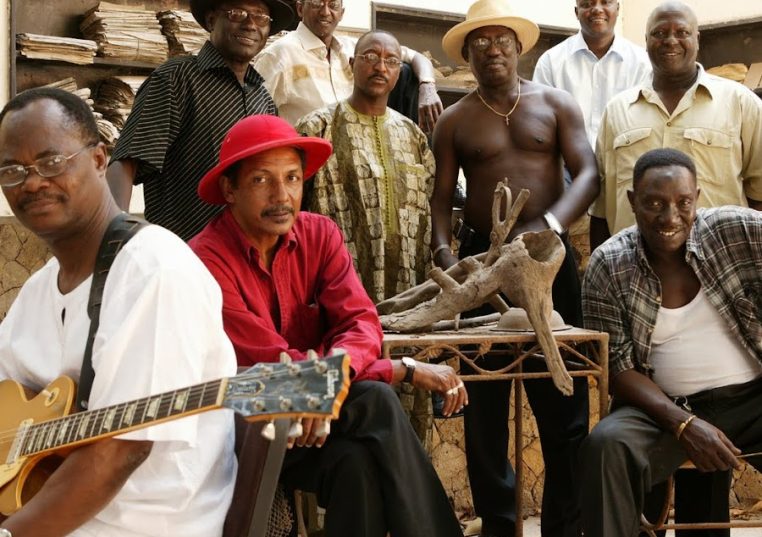
Orchestra Baobab is a Senegalese band established in 1970 as the house band of the Baobab Club in Dakar. Many of the band’s original members had previously played with Star Band de Dakar in the 1960s. Directed by timbalero and vocalist Balla Sidibé, the group featured saxophonists Issa Cissoko and Thierno Koité, two singers, two guitarists and a rhythm section with drums, congas and bass guitar. Since their formation, the band has predominantly played a mix of son cubano, Wolof music, and to a lesser extent Mande musical traditions. Following the deaths of Cissoko in 2019 and Sidibé in 2020, Thierno Koité has become the leader of the band. Many of the original members were veterans of the famous Star Band, whose alumni later included the Étoile de Dakar, El Hadji Faye and Youssou N’Dour. Star Band were the resident band of the upscale Dakar Miami Club. When the Baobab Club opened in Dakar in 1970, six musicians, led by saxophonist Baro N’Diaye, were lured from Star Band and the Orchestra Baobab was born. The club, in turn, is named for the baobab tree (Adansonia). The original frontmen of the band were the Casamance singers Balla Sidibé and Rudy Gomis, who came from the melting pot of Casamance musical styles, and most famously Laye M’Boup, who provided vocals in the Wolof griot style. His Wolof language lyrics and his soaring, nasal voice defined the sound of Baobab’s early hits. Togolese guitarist and arranger Barthélémy Attisso was a law student in Dakar, and a self-taught musician, whose arpeggiated runs became instantly recognizable. With the saxophone of Baro N’Diaye, this was the first core of the band. After touring Cameroon in 1971, N’Diaye was replaced by tenor saxophonist Issa Cissoko, who became leader of the band, and was joined by clarinettist Peter Udo.[1] Both Cissoko and drummer Mountaga Koité were from Maninka griot families, from Mali and eastern Senegal, respectively. The group’s lineup was rounded out by the slow groove Latin styles of Latfi Benjeloum (rhythm guitar), who came from a Moroccan family exiled to Saint-Louis, Senegal, and Charlie N’Diaye (bass) from Casamance. The group’s first recordings were released as Orchestre Saf Mounadem on a split album with Orchestre Laye Thiam, another band of ex-Star Band musicians. Attisso is credited as musical director, and singers Balla Sidibé and Medoune Diallo (who had stayed with the Star Band a bit longer than the others), along with Issa Cissoko are also credited on the cover. Like most of the recordings by Star Band, the album was produced by Ibrahim Kassé, and was later reissued in France under the title Star Band de Dakar Vol. 7. Their first two albums under the name Orchestra Baobab, were recorded at the Baobab Club between 1970 and 1972, and self-produced by the band. Both bear the title Orchestre du Baobab.