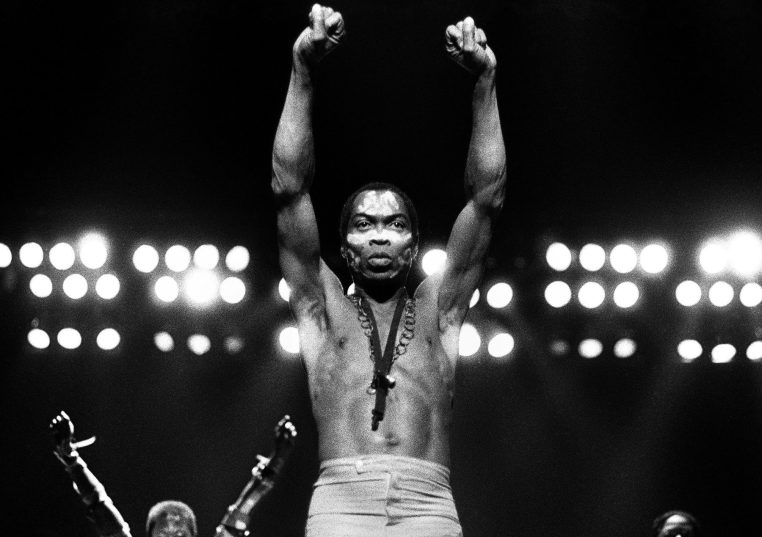
Fela Aníkúlápó Kútì (born Olufela Olusegun Oludotun Ransome-Kuti; 15 October 1938[1] – 2 August 1997), also known as Abàmì Ẹ̀dá, was a Nigerian musician, bandleader, composer, political activist, and Pan-Africanist. Kuti was the son of Nigerian women’s rights activist Funmilayo Ransome-Kuti. After early experiences abroad, he and his band Africa 70 (featuring drummer and musical director Tony Allen) shot to stardom in Nigeria during the 1970s, during which he was an outspoken critic and target of Nigeria’s military juntas.[4] In 1970, he founded the Kalakuta Republic commune, which declared itself independent from military rule. The commune was destroyed in a 1978 raid that injured Kuti and his mother.[5] He was jailed by the government of Muhammadu Buhari in 1984, but released after 20 months. He continued to record and perform through the 1980s and 1990s. Since his death in 1997, reissues and compilations of his music have been overseen by his son, Femi Kuti. Olufela Olusegun Oludotun Ransome-Kuti[6] was born into the Ransome-Kuti family, an upper-middle-class Nigerian family, on 15 October 1938 in Abeokuta (the modern-day capital of Ogun State[7]), which at the time was a city in the British Colony of Nigeria.[8] His mother, Chief Funmilayo Ransome-Kuti, was an anti-colonial feminist, and his father, Reverend Israel Oludotun Ransome-Kuti, was an Anglican minister, school principal, and the first president of the Nigeria Union of Teachers.[9] Kuti’s parents both played active roles in the anti-colonial movement in Nigeria, most notably the Abeokuta Women’s Riots which was led by his mother in 1946.[10] His brothers Beko Ransome-Kuti and Olikoye Ransome-Kuti, both medical doctors, were well known nationally.[5] Kuti Is a cousin[11] to the writer and laureate Wole Soyinka, a Nobel Prize for Literature winner.[12] They are both descendants of Josiah Ransome-Kuti, who is Kuti’s paternal grandfather and Soyinka’s maternal great-grandfather. On 3 August 1997, Kuti’s brother Olikoye Ransome-Kuti, already a prominent AIDS activist and former Minister of Health, announced that Kuti had died on the previous day from complications related to AIDS. Kuti had been an AIDS denialist,[40] and his widow maintained that he did not die of AIDS.[41][42] His youngest son Seun took the role of leading Kuti’s former band Egypt 80. As of 2022, the band is still active, releasing music under the moniker Seun Kuti & Egypt 80.