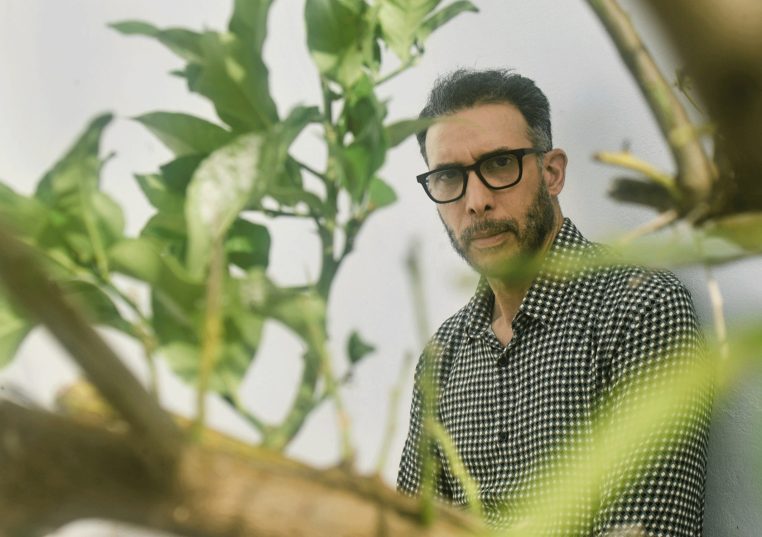
Mounir Fatmi was born in Tangier, Morocco, in 1970. At the age of four, his family moved to Casablanca. At seventeen he left for Rome where he enrolled in the free school of nudes and engraving at the Academy of Fine Arts, then at the School of Fine Arts in Casablanca and finally at the Rijksakademie in Amsterdam. He spent his childhood in the flea market in the Casabarata district, one of the poorest neighborhoods in the city of Tangier, where his mother sold children’s clothing. An environment that excessively multiplies waste and end-of-life consumer items. The artist subsequently sees this childhood as his first artistic education and compares this flea market to a ruined museum. This vision also has metaphorical value and expresses the essential aspects of his work. Influenced by the idea of dead media and the collapse of industrial and consumerist civilization, he develops a reflection on the status of the work of art between Archive and Archaeology. He uses obsolete materials such as antenna cables, old typewriters, or VHS tapes, and works on the notion of experimental archeology by examining the role of the artist within a society in crisis. . He plays with the codes and precepts of the latter under the prism of the trinity of Language, Architecture and Machine. He thus questions the limits of memory, language and communication, while reflecting on materials in the process of obsolescence and their uncertain futures. Mounir Fatmi’s artistic research constitutes a reflection on the history of technologies and their influences in popular culture. We must therefore see in his works, future media archives under construction. Although they mark key moments in our contemporary history, Since 2000, mounir fatmi’s installations have been selected in several biennials, the 52nd and 57th Venice Biennial, the 8th Sharjah Biennial, the 5th and 7th Dakar Biennial, the 2nd Seville Biennial, the 5th Gwangju Biennial , the 10th Lyon Biennial, the 5th Auckland Triennial, the 10th and 11th Bamako Biennial, the 7th Architecture Biennial, Shenzhen, the Setouchi Triennial and the Echigo – Tsumari Triennial, in Japan. His work has been presented in numerous personal exhibitions at the Migros Museum für Gegenwarskunst, Zurich. Mamco, Geneva. Picasso Museum, War and Peace, Vallauris. AK Bank Foundation, Istanbul. Museum Kunst Palast, Düsseldorf and at the Goteborg Konsthall. He has participated in several group exhibitions at the Center Georges Pompidou, Paris. Brooklyn Museum, New York. Palais de Tokyo, Paris. MAXXI, Rome. Mori Art Museum, Tokyo. MMOMA, Moscow. Mathaf, Doha. Hayward Gallery and Victoria & Albert Museum, London. Van Abbemuseum, Eindhoven, the Nasher Museum of Art, Durham and the Louvre Abu Dhabi.