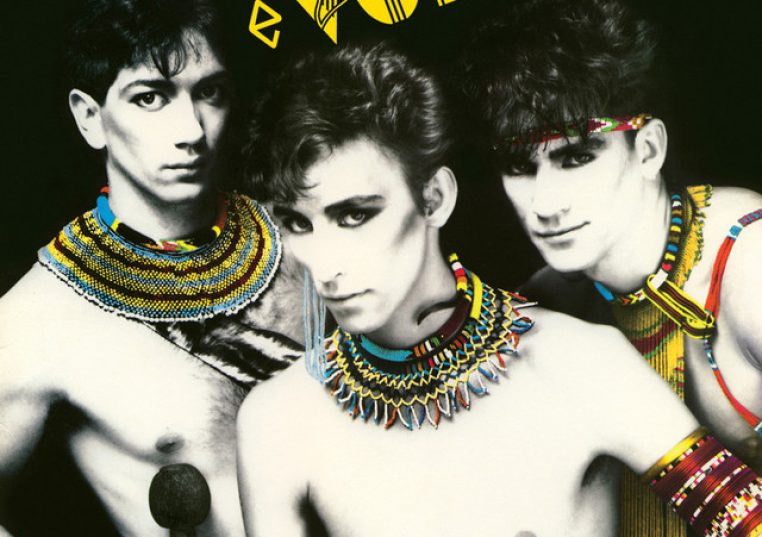
éVoid is a rock band that emerged in 1980s South Africa.[1] A three-piece rock outfit, it featured the brothers Lucien and Erik Windrich and various drummers Georg Voros, Wayne Harker and Danny de Wet. Erik played keyboards and sang lead vocal, while Lucien played guitar and provided backing vocals. éVoid became the most successful and influential of the South African punk bands to take up African-inspired images and sounds in their sonic rebellion against apartheid. The liner notes, written by Michael Waddacor, on the Fresh Music CD re-issue of éVoid and . . . Here Comes the Rot provides a lengthy and exacting musical history of the trio. The group was formed in 1977 in Brakpan on the gold-rich reef of the Witwatersrand. Lucien Windrich, who was born in November 1958 in the Netherlands, began playing in a Brakpan band called “Zennith” with high school friends that included bassist Benjy Mudie, the future South African music custodian. The band changed its name to “Void” in 1977, and the following year was joined by Lucien’s younger brother, Erik (born February 1960, also in the Netherlands). In 1978, even though Void had won that year’s “Battle of the Bands” contest on the Witwatersrand, they were still struggling to find a decent paying gig in the country. An opening presented itself in Rhodesia – a country where audiences were starved of good live rock music. While spending eight months there, along with drummer Danny de Wet (later of Petit Cheval and Wonderboom) and bassist Terry Andalis, in 1979 the band recorded a cover of the Knack’s current hit, “My Sharona”. But it was the B-side “Magicia” that took off and reached number 4 on the country’s charts. Returning to South Africa, the group re-assessed its identity following the departure of Terry Andalis, José “Aggi” D’Aguiar & finally Danny De Wet in 1982 (at the end of a contract in Port Elizabeth). Lucien, Erik and third brother Karl, the band’s manager, changed the name to “éVoid” and it became a three piece with Georg Voros on drums. Early in 1983, another change occurred when Wayne Harker took over from drummer, Georg Voros. éVoid quickly built up a following of enthusiastic fans, that started in East London and spread nationally over a period of four years. The members were creating a more finely balanced and subtle fusion of Afro-rock (which they called “ethnotronics”), which was different from the more traditional sounds of their contemporaries, Juluka and Hotline, or the rock-based Tribe After Tribe, Ella Mental, Via Afrika, Flash Harry and Neill Solomon’s Passengers. However, like other Afro-rock bands, éVoid conveyed immediacy, simplicity and warmth of spirit. Managed and promoted by a third Windrich brother, Karl, éVoid now upped their image with painted faces, tribal dances and South African jive rhythms. Success arrived when WEA (now Tusk Music) in Johannesburg signed them to a recording contract. Simply called éVoid, the debut album yielded the first single, “Shadows”, which was released in August 1983. It was backed with the infectious “Dun Kalusin Ta Va”, which had become a hallmark of their sound. “Shadows” peaked at number three on the national charts in November and, to this day, remains a staple of South African rock and pop-oriented radio stations. The liner notes for the 2000 CD release of “éVoid” described Lucien as living in North London with his partner Cathy and their son and daughter, while studying astrology and reading for a degree in anthropology. Erik and his partner, Alix, a lawyer, are living in North-West London with their daughter and her three children. He won a place on the two-year postgraduate course at England’s National Film and Television School. He has commented that arriving in London in 1985 and trying to earn a living as respected musicians has rarely been easy, and éVoid’s arrival in London at the time of South Africa’s State of Emergency made people suspicious of them. They did, however, benefit from some lucky breaks and, over the following decade, played many club and festival gigs in Britain and on the Continent, most notably Germany. Wayne Harker maintained his career in music. After the dissolution of Askari in Cape Town, he was summoned to rejoin the band (with Ilne Hofmeyr) and record fresh material. He spent about four years in the band in the late 1980s and the early 1990s, which included a six-week tour of Germany. Obtaining a work permit in Germany, he met and married a local girl and settled in Cologne. In time, he developed his musical talents to include bass guitar and the keyboards, and writes and records his own original music. In 2008, after a lengthy hiatus, the Windrich brothers and original eVoid drummer Georg Voros released another éVoid album, Graffiti Lounge. Reviewing the CD, Johannesburg newspaper The Citizen wrote: “The songwriting power is still very much in evidence, and what could have been a tricky career stumble is, without doubt, a triumph.” Erik is currently employed as the Creative and Performance Manager at Kingsbury High School, London.