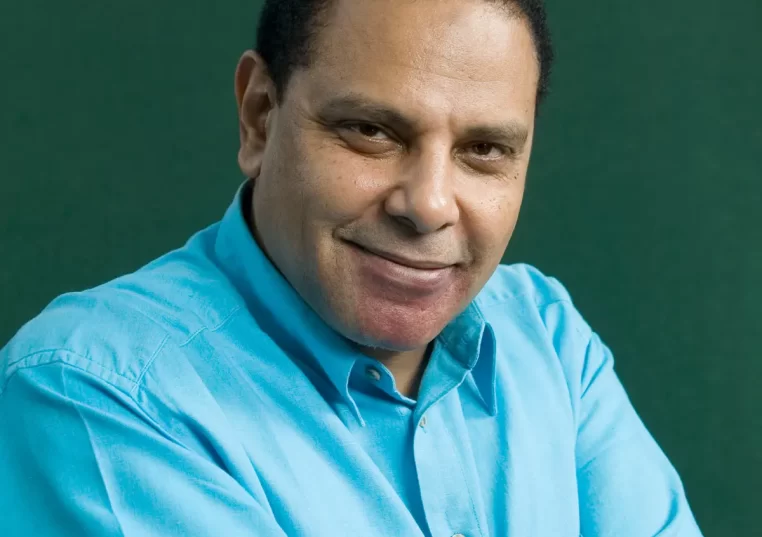
Alaa Al Aswany, born in Cairo in 1957, hails from a family with a history of intellectual and political involvement. His mother, Zainab, came from an aristocratic background, while his father, Abbas Al Aswany, was a prominent lawyer and writer. Sadly, Abbas passed away when Alaa was 19. Alaa Al Aswany’s educational journey took him to Le Lycée Français in Cairo, where he later earned a bachelor’s degree in dental and oral medicine at Cairo University in 1980. His pursuit of higher education led him to the University of Illinois at Chicago, where he completed a master’s degree in dentistry in 1985. Alaa Al Aswany is multilingual, fluent in Arabic, English, French, and Spanish, and has even studied Spanish literature in Madrid. He has been married twice, with his second marriage resulting in two daughters, May and Nada. Beyond dentistry, Alaa Al Aswany established himself as a prolific writer and political commentator. He contributed to various newspapers and publications, both in Egypt and internationally, including The New York Times, Le Monde, El Pais, The Guardian, and others. His literary works, including his second novel, “The Yacoubian Building,” have been translated into 37 languages. The novel, known for its satirical take on modern Egyptian society, was adapted into a highly successful movie and a television series. During the Egyptian Revolution of 2011, Alaa Al Aswany’s writings were seen as influential in inspiring protesters. His novel “Chicago,” set in the city of his education, was published in 2007, and “Automobile Club of Egypt” was released in English in 2016. He earned recognition on a global scale, being named one of the 500 Most Influential Muslims in the World and topping The Foreign Policy Top 100 Global Thinkers list in 2011. In his novel “Jumhuriyat ka’an” (translated as “The Republic of False Truths”), published in 2018, Alaa Al Aswany delves into the backdrop of the 2011 Revolution. Alaa Al Aswany’s diverse contributions as a writer, dentist, and political commentator have solidified his place as a significant figure in Egyptian literature and society.